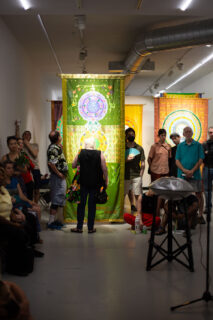
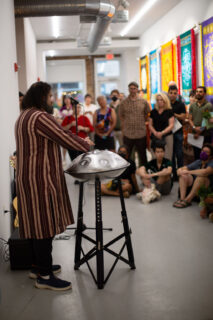
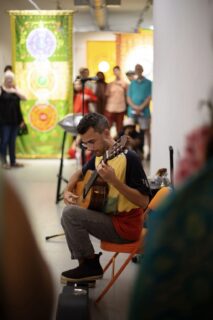
As I wandered into the opening of Climate Mandalas in a Burning World: Portals of Transformation, I was struck by the kaleidoscopic nature of the exhibition and the rhythmic live acoustic guitar trickling through a room otherwise almost in complete silence. A grounded sense of collective presence enveloped the room as I carefully made my way through the crowd toward the middle of the space. I felt in my body an invitation to be wholly in connection, and the white walls disappeared. I remembered them only when I noticed the shadow of one of the golden Hamsa (swan)- tipped rods that suspend Misra’s work along the length of the gallery.
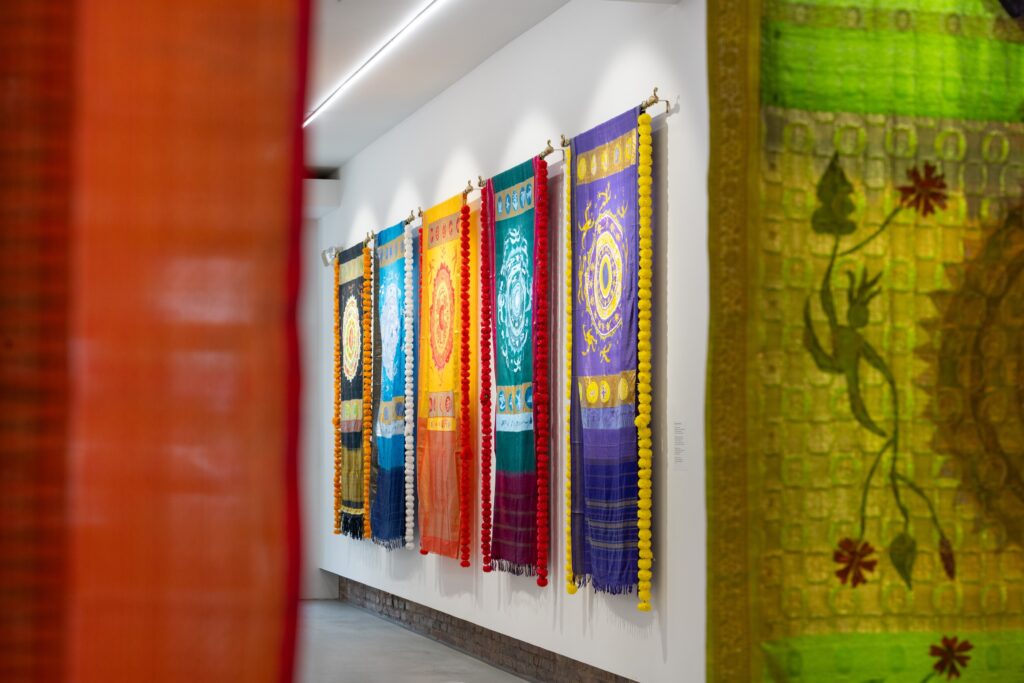
Installation view of “Climate Mandalas In A Burning World: Portals of Transformation” Hamiltonian Artists, July 12–August 16, 2025. Photo: Vivian Marie Doering
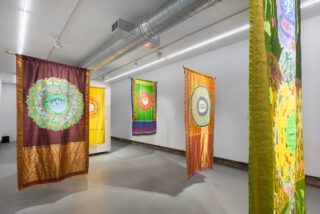
Her monumental Elementary Mandala Portals series dances gently with the air as you enter the room. Hung side by side, the five painted sarees meditate upon fire, water, earth, air, and spirit. Together, they represent the “seed of regenerative climate solutions and possibilities” and invoke Ayurveda, the ancient holistic system of medicine that emerged in India more than 5,000 years ago. A climate poem by Misra—commissioned in 2022 as part of a collaborative performance with MAD Dance in Frederick, Maryland—inspired these mandalas and draws viewers into a portal journey, with corresponding fragments of verse installed beside each work.
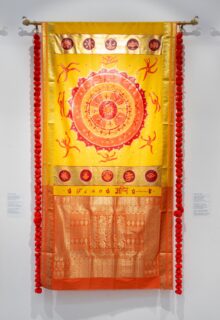
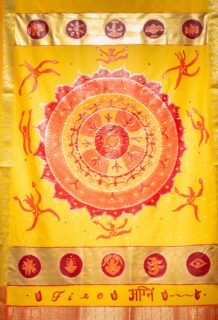
Situated at the center of the grouping, Rekindling Our Sacred Fire (2025) serves as both conceptual and visual genesis, responding to literal and symbolic fires in the age of climate change. A yellow saree patterned in orange and gold forms its ground, hanging from one of the swan rods and framed by chains of red marigolds on either side. Two golden bands, painted parallel to the saree’s end pattern, hold five symbols each: in the upper strip, a central fire dancer—an ode to the Kalbelia women fire dancers of Rajasthan—appears alongside a bird-shaped Vedic fire altar, a drum as a call to action, fire-adapted germinating seeds, and the chariot of Agni, the Hindu god of fire; in the lower strip, a traditional fire keeper anchors images of the mythic bird Garuda, a third eye of discernment, a lamp representing sacred fire, and a flower evoking photosynthesis and solar energy. Between these bands, five concentric circles interweave celestial bodies, phoenix-like birds, and beings gathered in rings of care. Alongside them are pyrophytic seeds awaiting germination—poised for renewal.
Neha Misra, “Rekindling Our Sacred Fire” (2025), acrylic, fiber, and dreams on upcycled family silk saree from India, 85 𐄂 44 inches. Photo: Vivian Marie Doering
Neha Misra, “Rekindling Our Sacred Fire” (detail) (2025), acrylic, fiber, and dreams on upcycled family silk saree from India, 85 𐄂 44 inches. Photo: Vivian Marie Doering
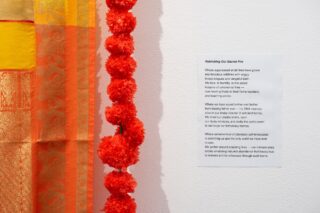
Neha Misra, “Rekindling Our Sacred Fire” (detail) (2025), acrylic, fiber, and dreams on upcycled family silk saree from India, 85 𐄂 44 inches. Photo: Vivian Marie Doering
On the exhibition checklist, Misra lists acrylic, fiber, and dreams as materials used. The sarees belong to the artist’s family members: “Amma’s sarees, my mother’s, my own, my sister-in-law’s from her wedding.” Some fabrics are older and more worn than others, echoing the bodies they once wrapped and their need for healing and repair—“as is the body of Mother Earth, which we humans are a part of.” Certain paints came from the home of Misra’s 83-year-old neighbor, Zina Pelkey, whose artist mother, Mary Dubro Pelkey, transitioned in 2010 at the age of 102. Even after sitting untouched for decades before her passing, the colors remain astonishingly vivid.
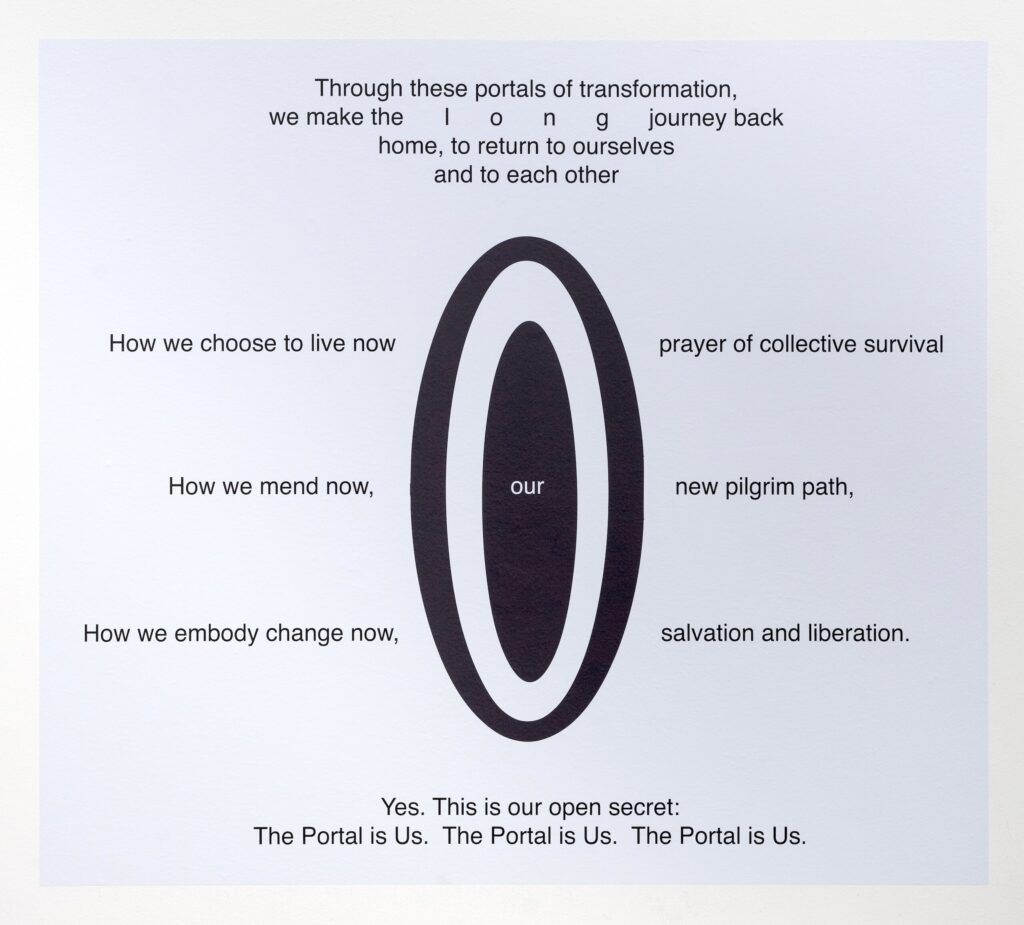
The final revelation of the climate poem appears nearby. With words arranged around an oval-shaped opening, it divulges an “open secret”: the portal of transformation—referenced in the title of the exhibition—is all of us.
Installation view of “Climate Mandalas In A Burning World: Portals of Transformation” Hamiltonian Artists, July 12–August 16, 2025. Photo: Vivian Marie Doering
In Sanskrit, “mandala” simply means “circle.” The word is used to describe a circular geometric arrangement of symbols, and the practice of its inscription serves as a tool for guiding one toward a state of wholeness. “How can we embody the sacred geometry of the circle to remember, reimagine, and recreate old and new ways of being and belonging in a world that, in the age of climate change, feels both literally and symbolically on fire?” Artist-organizer Neha Misra asks, all in one breath.
As a self-described “outsider-insider” in the Art World, Misra often brings attention to a question that may have crossed your mind at art openings: how often is a solo show the result of one person’s labor? Since her first major presentation of artworks in Dreams of Earth Renewal at Sandy Spring Museum in 2023, she has been playing with the word “unsolo” as a reorientation. This is not a semantic gesture alone but one embodied throughoutthe collective efforts surrounding this exhibition—conceptually, materially, and relationally. When the gallery quiets, one can hear Elementary Beings, a musical composition produced through long-distance collaboration between Arvind Venugopal (DC) and Priya Parrotta (Vermont)—weaving another layer into the exhibition’s multisensory field. At the opening, Venugopal performed alongside Rahul Mukherjee of Tvameva, as well as Aaron Lewis of Temperance Alley Garden and Marco Pflanzen from Winchester, Virginia.
The exhibition balances multiple tensions in the making: solitude and gathering, symmetries and asymmetries, precise measurement and surrender to the human hand, art for self-realization and art for collective catharsis. Created in honor of environmental organizations whose impact spans many scales and strategies, Misra’s Climate Solutions Mandalas cascade through the center of the gallery and immerse visitors in a procession of portals.
Installation view of “Climate Mandalas In A Burning World: Portals of Transformation” Hamiltonian Artists, July 12–August 16, 2025. Photo: Vivian Marie Doering
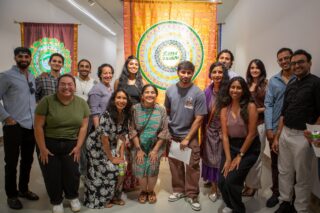
View of “Climate Mandalas In A Burning World: Portals of Transformation” exhibition opening at Hamiltonian Artists. Photo by Senna Ahmad, courtesy of the artist.
View of “Climate Mandalas In A Burning World: Portals of Transformation” exhibition opening at Hamiltonian Artists. Photo by Senna Ahmad, courtesy of the artist.
View of “Climate Mandalas In A Burning World: Portals of Transformation” exhibition opening at Hamiltonian Artists. Photo by Senna Ahmad, courtesy of the artist.
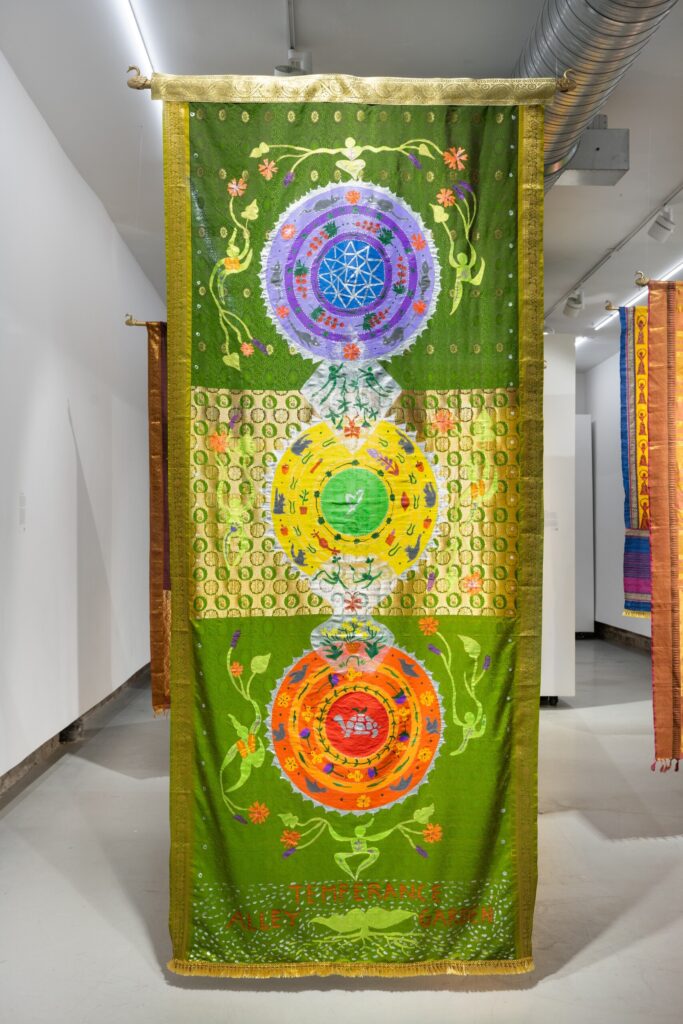
Misra maintains deep, ongoing relationships with each partner, and these connections shape the artworks themselves. Temperance Alley Garden Mandala (2025) draws inspiration from the community-driven urban garden located in the U Street Corridor, just blocks away from Hamiltonian Artists. Their grassroots initiative combines local food production, environmental stewardship, and public engagement to connect neighbors with sustainable practices. An ornate green saree was handpicked by garden co-stewards Aaron Lewis and Josh Morin as the backdrop for this work because of the lushness of its existing patterns. They also offered source sketches for many of the meaningful symbols that made their way into the painted mandala map—Elli the turtle, pigeons, squirrels, rats, tomatoes, marigolds, squash vines, mulberry flowers with leaves of differing symmetries and asymmetries, and heart symbols doodled during community conversations. Misra was introduced to the community through her collaborator Fid Thompson, with whom she co-created Nature of Us, a transdisciplinary eco-art project that celebrates human-nature love stories in urban landscapes.
Neha Misra, “Temperance Alley Garden Mandala” (2025), acrylic, fiber, and dreams on upcycled family silk and cotton saree from India, 44 𐄂 100 inches. Photo: Vivian Marie Doering
As we sit together, Misra reflects on learnings from the North Carolina Climate Justice Collective’s TapRoot Artist Residency in 2024. Developed by Jodi Lasseter, NCCJC’s co-founder and co-director, the “4Rs of social transformation” framework invites participants to Resist, Reform, Reimagine, and Recreate—asserting there is a place for all of this. “Some people spend all their energy on resistance”—a noble endeavor in the face of so much, we acknowledge—but “what does it mean to not singularly do that for the circle to be whole?”
Other partner organizations include Green Dharma, a program of Interfaith Power & Light (DC. MD. NoVA), The Nature Conservancy’s Women & Allies in Climate Initiative, and Remote Energy. Misra’s Remote Energy Solar Mandala (2025) reflects on their initiative, which trains women to install and maintain solar photovoltaic systems. Their mandala is cut from the same cloth as Rekindling Our Sacred Fire (2025), and the designs around the outermost circle similarly evoke the sun’s rays, though in a more rigid, angular style. Eight engineers in construction hats, each with a whimsical hairstyle shaped like the ohm symbol of electrical resistance, are positioned across concentric circles of sun signs, solar panels, and lightning bolts. At the center are the organization’s name and compass logo. Misra connected with Remote Energy co-founders Carol Weis and Laura Walters by way of We Care Solar, where they taught her about photovoltaic technology during her earlier role as co-founder of Solar Sister.
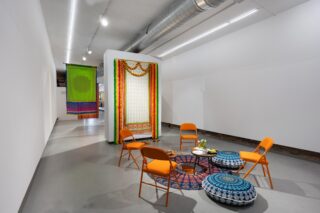
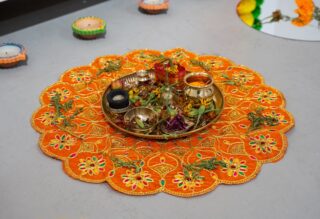
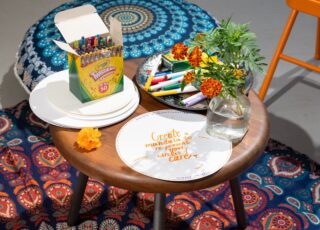
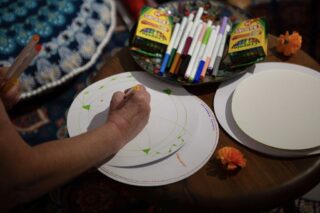
Framed by marigold flowers, a vintage cotton saree that belonged to Misra’s mother hangs toward the back of the gallery, creating a soft altar with pillows beneath it. Here, visitors are invited to sit, draw mandalas, and write reflections in the guestbook. The reflections recognize the project as an act of hope and “a space where connection, sadness, hope, joy, reckoning, and possibility can all exist together.” A similar spirit carries through to Misra’s generous Color Portals artist newsletter, where she shares the labor, insights, and layered practice behind the family saree mandalas while expressing gratitude for collaborators and participants. In a world that often flattens these connections, she leaves them visible as a meticulous map for others to follow.
Installation view of “Climate Mandalas In A Burning World: Portals of Transformation” Hamiltonian Artists, July 12–August 16, 2025. Photo: Vivian Marie Doering
Installation view of “Climate Mandalas In A Burning World: Portals of Transformation” Hamiltonian Artists, July 12–August 16, 2025. Photo: Vivian Marie Doering
Installation view of “Climate Mandalas In A Burning World: Portals of Transformation” Hamiltonian Artists, July 12–August 16, 2025. Photo: Vivian Marie Doering
View of “Climate Mandalas In A Burning World: Portals of Transformation” exhibition opening at Hamiltonian Artists. Photo by Senna Ahmad, courtesy of the artist.
The World Meteorological Organization reports that 2024 was the hottest year on record, rounding out a decade in which every single year landed in the “top ten,” as climate disasters like heat waves, floods, and wildfires continue to intensify around the globe. At a moment that can be seen as both a warning and a call to deeper awareness, Misra activates the gallery as a hub for conversation, inviting reflection, imagination, and dialogue around how communities, ideas, and practices can come together to respond to the climate crisis. In alignment, her Climate Solutions Mandalas are being gifted to each partner organization—so that they might remain rooted in the solidarity and advocacy that brought them into being.
Ultimately, Climate Mandalas in a Burning World: Portals of Transformation leaves us not with a singular answer, but with a circular tapestry of answers that opens onto more questions: How do we act, imagine, and care together amidst so much uncertainty? The exhibition’s woven network of symbols, stories, and relationships insists that pathways to healing our planet and ourselves can hold complexity, embody strategy, and invite participation. Misra’s “unsolo” exhibition models an ecosystem of multilayered climate justice, where creativity, reflection, and collaboration coexist, offering both a mirror and a guide for how we might engage, repair, and reimagine our shared world.
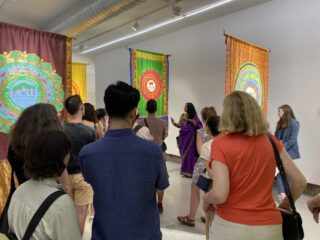
View of “Climate Mandalas In A Burning World: Portals of Transformation” exhibition walkthrough at Hamiltonian Artists. Photo: Hannah Chen
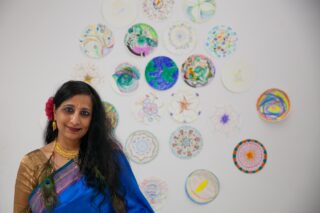
Portrait of Neha Misra. Photo by Fid Thompson, courtesy of the artist.
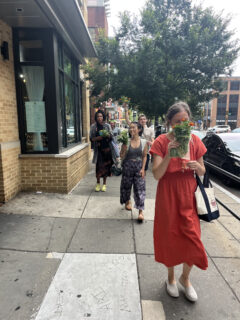
Green Dharma Climate Mandalas Social. Photo by Senna Ahmad, courtesy of Interfaith Power & Light (DC. MD. NoVA)
Mojdeh Rezaeipour is an Iranian-born transdisciplinary artist and writer whose practice activates personal and collective archives through iterative long-term projects, collaborative research, and pedagogical engagement.
On the heels of 2024, the hottest year on planetary record, Neha Misra नेहा मिश्रा centers collective ways of being and belonging as the portals of transformation that today’s age of climate change demands.…