Nilou Kazemzadeh: How to Remain Tender, How to Find Your Roots
By Laila Abdul-Hadi Jadallah
To witness something bear fruit is to understand all that came before and together to make it possible.
Persian carpets, Rumi, and pistachios—Iranian craftsmanship, poetry, and food are popular culture items at least known, if not widely appreciated, by your average American. And at the same time, the image of Iran as an unhinged evil seeking nuclear power is also habitually invoked by those who aim to wield power—and arguably, worse, by those who don’t pause to question what they are told or being sold to support. The overly simplified, heavily propagandized, and sometimes schizophrenic way that Americans see West Asia (the Foreign Other) is unavoidable.
There is a certain tenderness required to be a person whose roots are simultaneously known and often misrepresented. In the work of Maryland-raised Iranian American artist Nilou Kazemzadeh, the simplified dichotomy through which Iranian culture and politics are often framed is made to feel, small. Not in a belittling sense, but in a way that reminds us that the ancient Persian history and culture that has influenced so much of the world, and its truncated modern history, exist in some version of the same world. Kazemzadeh’s debut solo exhibition at Hamiltonian Artists, I Witnessed the Garden Bear Fruit, disarms the social constructs of difference and indifference which seem to plague so much of the contemporary moment, and works to erase it gently and thoughtfully with her hands.
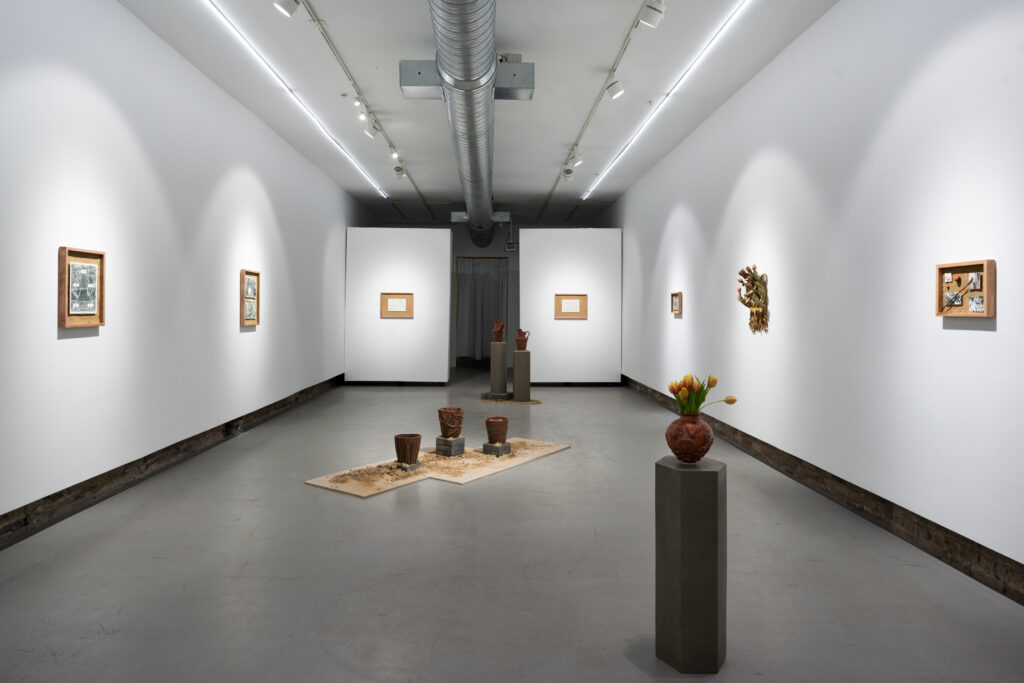
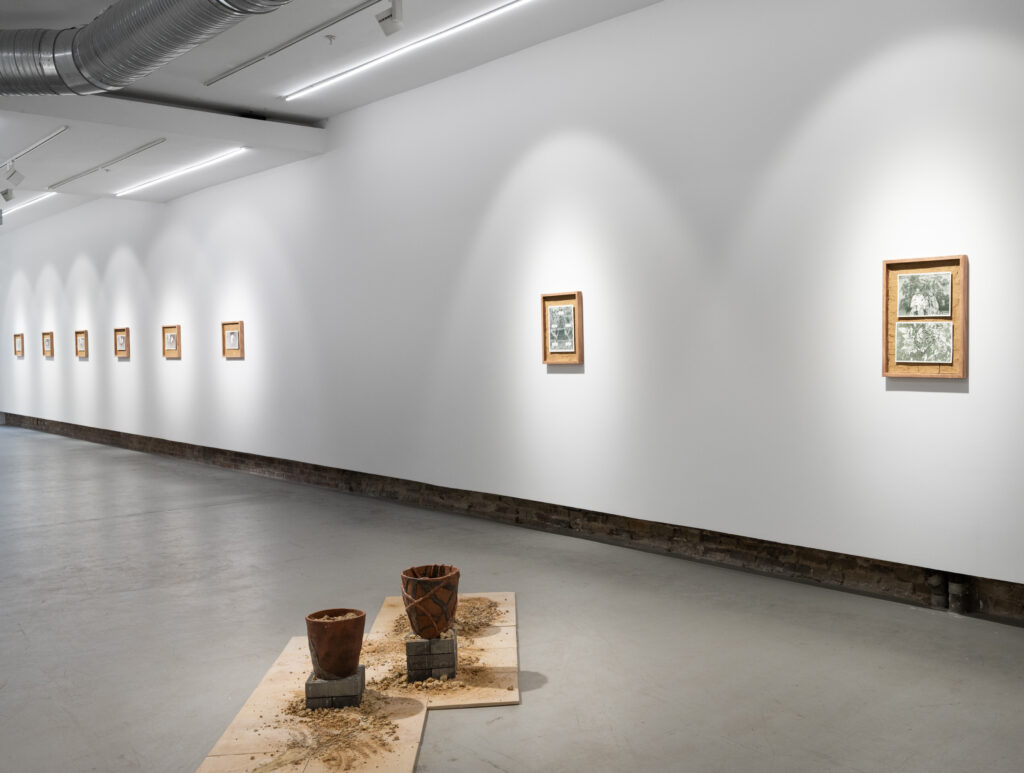
Installation view of “I Witnessed the Garden Bear Fruit,” Hamiltonian Artists, March 28-May 2, 2026.Photo: Vivian Marie Doering.
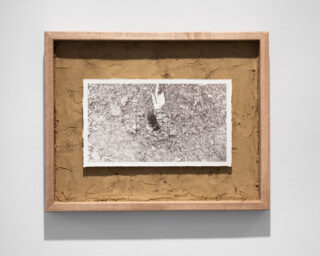
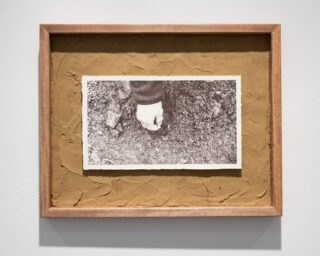
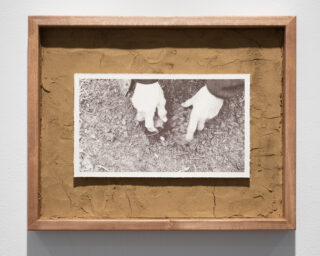
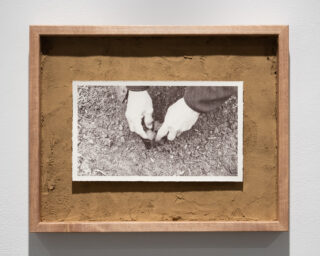
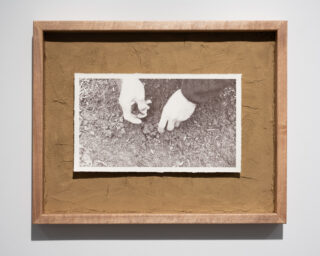
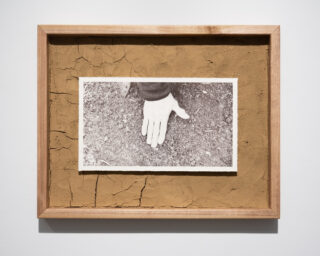
Throughout the exhibition, which features 21 artworks across media made between 2024 and 2026, the hand is ever present. It appears literally, as a useful, caring part of the body, and as an ever-present being which has planted the seeds we now sow, shaped the objects around us, and connects us to our ancient ancestors. As one enters, they encounter Take Care (2026), a new series of six monotone film stills from a 2024 film that is also on view. Images of the artist’s father’s hands, in various gestures of planting seeds, float in wooden frames with hand-pressed mats of dried Maryland dirt. This series of images is the first invitation to witness what a shared world has to offer.
Nilou Kazemzadeh, "Take Care I" (2026), photolithographic print on BFK Rives paper, mud, and wooden frame, 20 x 16 inches. Photo: Vivian Marie Doering.
Nilou Kazemzadeh, "Take Care II" (2026), photolithographic print on BFK Rives paper, mud, and wooden frame, 20 x 16 inches. Photo: Vivian Marie Doering.
Nilou Kazemzadeh, "Take Care III" (2026), photolithographic print on BFK Rives paper, mud, and wooden frame, 20 x 16 inches. Photo: Vivian Marie Doering.
Nilou Kazemzadeh, "Take Care IV" (2026), photolithographic print on BFK Rives paper, mud, and wooden frame, 20 x 16 inches. Photo: Vivian Marie Doering.
Nilou Kazemzadeh, "Take Care V" (2026), photolithographic print on BFK Rives paper, mud, and wooden frame, 20 x 16 inches. Photo: Vivian Marie Doering.
Nilou Kazemzadeh, "Take Care VI" (2026), photolithographic print on BFK Rives paper, mud, and wooden frame, 20 x 16 inches. Photo: Vivian Marie Doering.
Foraging clay and exploring the natural landscape of the Piedmont region of Maryland, where she lives, is central to this body of work and Kazemzadeh’s broader practice. Using printmaking, ceramics, video, drawing, and reimagined ordinary family photographs, she bridges the vast materiality, history, and culture of both Maryland and her ancestral home of Iran, quite literally, in a natural way.
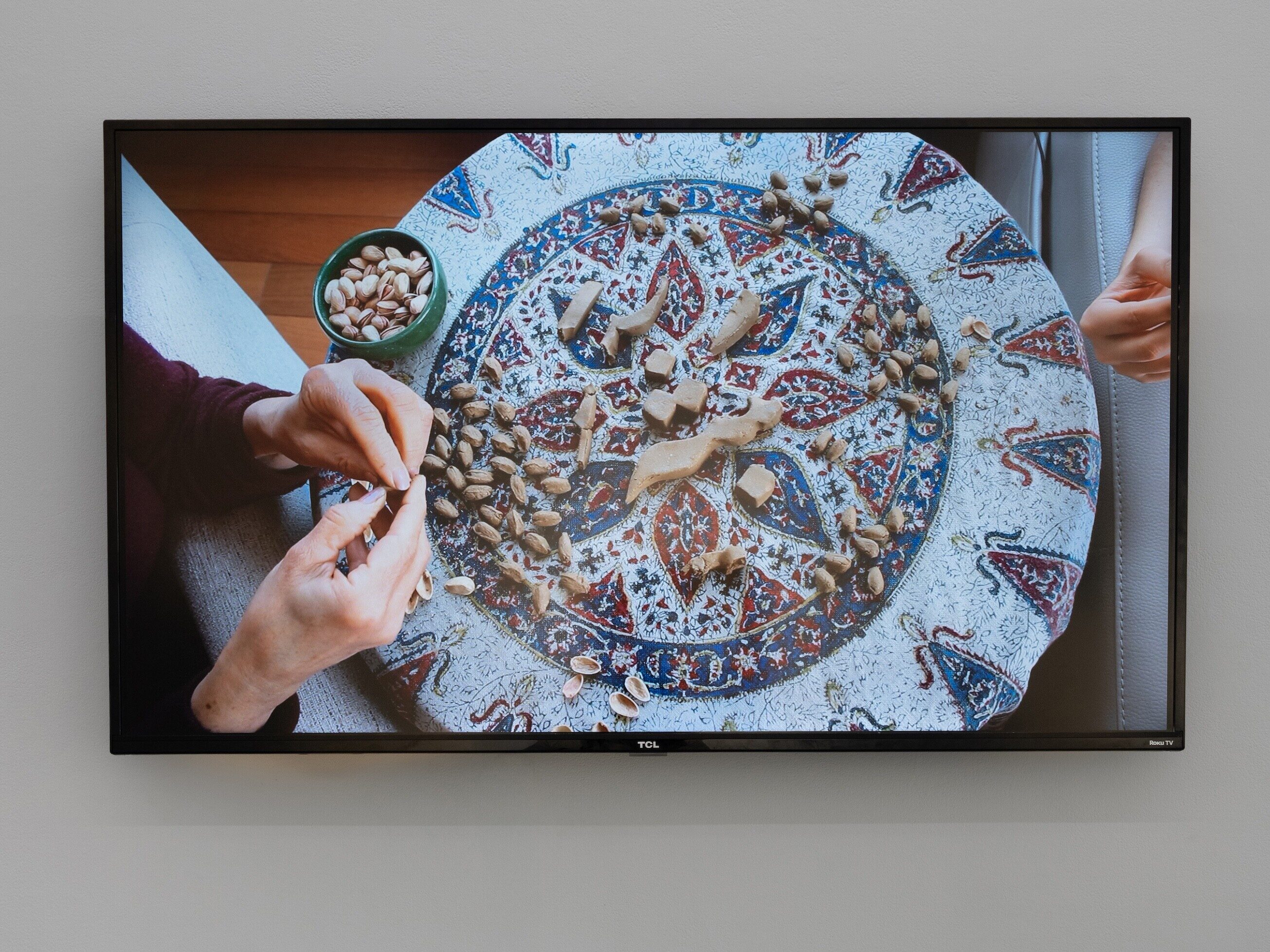
The installation is muted, with numerous shades of natural brown. Framed mixed-media works incorporating drawing, prints, photographs, and clay sculptures are separated by feet, but not distant, allowing the relationships between the subject matter addressed and materiality employed to breathe, yet remain in conversation—each work, an act of connecting one event to another, one place to another, and one history to another. Kazemzadeh’s family appears again in the 2024 short durational film, A Mighty Tree Uprooted (2024). In it, the artist’s and her mother’s hands carefully pull pieces of Maryland clay from the center of a table and use pistachio shells to shape them, gesturing toward the shared familial practices that bridge her family’s history in Iran with the new roots that took hold in Maryland.
Nilou Kazemzadeh, “A Mighty Tree Uprooted” (2024), color video, silent, 11:37 minutes. Photo: Vivian Marie Doering.
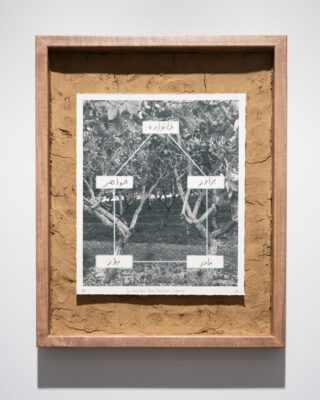
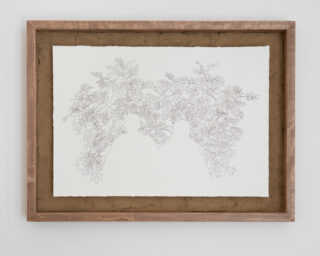
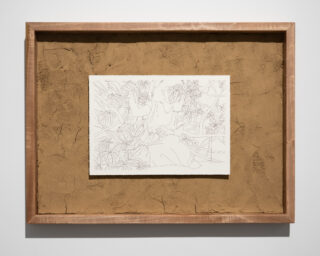
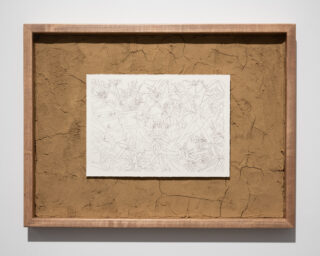
Other two-dimensional framed works in the exhibition include the screenprint, You Are Proof Your Ancestors Survived (2026), and a series of photolithographs titled Tracing Family Archives (2026). Creatively reusing her family archive of photos, each work demonstrates the artist’s expert use of subversion through repeated motifs of trees and plant life. From tracing figures in landscapes that blur the lines between plant and human, to displaying mixed-media portraits of her family and their garden in Iran, Kazemzadeh creates a physical connection between built and natural environments. These images of everyday life remind us of shared practices held by people all over the world. Gathering around food and place, sharing the earth’s abundance, and tending to our relationship with kin is something ancient and common. For Kazemzadeh, the depths of exploring place are boundless and interconnected.
Nilou Kazemzadeh,"You Are Proof Your Ancestors Survived" (2026), screenprint on paper, graphite, white chalk pastel, mud, and wooden frame, 20 x 16 inches. Photo: Vivian Marie Doering.
Nilou Kazemzadeh, "Tracing Family Archives (Grandparents)" (2026), photolithographic print on BFK Rives paper, mud, and wooden frame, 24 x 18 inches. Photo: Vivian Marie Doering.
Nilou Kazemzadeh, "Tracing Family Archives (Mother)"(2026), photolithographic print on BFK Rives paper, mud, and wooden frame, 24 x 18 inches. Photo: Vivian Marie Doering.
Nilou Kazemzadeh, "Tracing Family Archives (Father)" (2026), photolithographic print on BFK Rives paper, mud, and wooden frame, 24 x 18 inches. Photo: Vivian Marie Doering.
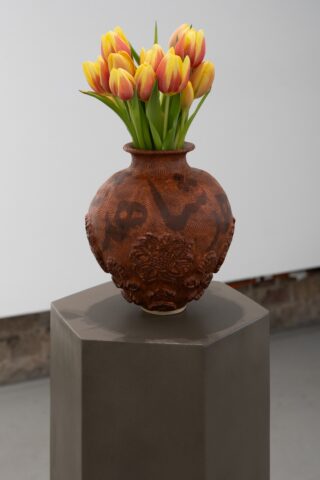
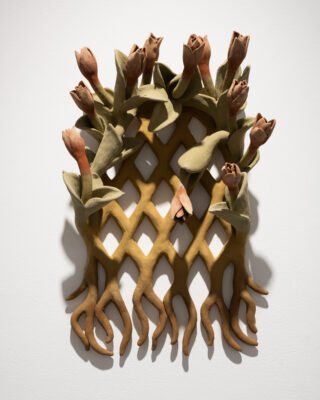
As one moves through the space, they encounter three areas with hand-built clay vessels that sit on the floor and on pedestals, serving as altars for reflection. Witness (2026), a vessel inscribed with the Farsi word “shahed,” holds fresh, yellow-tipped tulips. It is another invitation to witness, as the term translates, what this shared world has to offer and another method of subversion. The flowers and the vessel are both made from this earth, but one will eventually wilt and disperse, and the other will remain useful in holding another life cycle. Created at the beginning of 2026 in response to the killings of women, children, and men during the economically led protests and the ongoing Israeli- and American-led war on Iran, the vase serves as an act of refusal. Nearby, a small wall-hung, loosely woven ceramic rug of roots sprouting into tulips titled Tulips Never Die (2024) connects the two works. Like the vase, it was created in response to violence during the 2024 Jina Mahsa Amini Protests. As an Iranian in diaspora, Kazemzadeh responds simultaneously to the indifference of American politics and its endless wars, and the use of force by the current Iranian regime—both of which utilize civil unrest to advance their own agendas— and the helplessness one feels as someone whose roots connect them to both geographies.
Nilou Kazemzadeh, "Witness" (2026), wild clay slip on ceramic and cement, cut tulips, dimensions variable. Photo: Vivian Marie Doering.
Nilou Kazemzadeh, "Tulips Never Die" (2024), wild clay slip on ceramic, earth pigments, and lake pigments, 24 x 9 x 15 inches. Photo: Vivian Marie Doering.
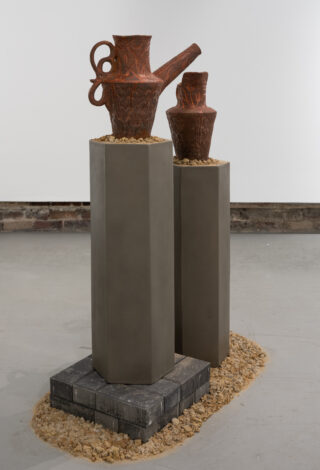
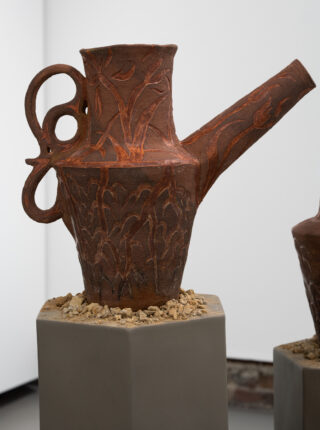
As one reaches the back of the gallery, a pair of vessels titled What Do you Pass On (2026) rest on pedestals. Made of foraged Maryland clay and ceramics with hand-embossed fauna and flora patterns,these functional objects could be used to water plants or serve water to guests. Interpreted as a closing statement for the exhibition, the work stands as a reminder of what could be shared rather than withheld.
"What Do You Pass On" (2026), wild clay slip on ceramic, clay, and cement, dimensions variable. Photo: Vivian Marie Doering.
"What Do You Pass On" (detail) (2026), wild clay slip on ceramic, clay, and cement, dimensions variable. Photo: Vivian Marie Doering.
In I Witnessed the Garden Bear Fruit, Kazemzadeh seizes the blank space of the white cube gallery as an opportunity to invite deeper thinking and connection. Drawing upon her skills in printmaking, a part of her practice for nearly a decade now, refining her use of natural materials, and playing with three-dimensionality, she offers a rebuttal to the systems of power that divide, dehumanize, and villainize.
The title of A Mighty Tree Uprooted (2024) echoes late Iranian dictator Ayatollah Khamenei, who with those same words, likened the Islamic Republic to an unrootable, unchangeable tree, during 2022 mass protests ignited by the death of Jina Mahsa Amini following her arrest in Tehran over improper hijab. Kazemzadeh uses a mundane act to reframe the Ayatollah’s words, reminding us that despite the dictator’s intention to liken something as tender as a tree to an unremovable, oppressive force, nature is cyclical. And that death, even though at times unfairly cruel and painful, may also mark a new beginning. The protests sparked by Amini’s death, those that have come before and followed, and new roots that are planted, illustrate just that.
Installation view of “I Witnessed the Garden Bear Fruit,” Hamiltonian Artists, March 28-May 2, 2026.Photo: Vivian Marie Doering.
While much of our current world makes us feel like so much is out of our hands, the artist’s use of foraged clay and natural pigments and reuse of familiar imagery that could be found in anyone’s family archive illustrates what a bit of reflection and a world built by hand can offer. An unassuming object of beauty can upend your worldview. Perhaps that is the exhibition’s greatest strength – the idea that the power to dismantle violent systems is already in our hands. We must first take a first step to touch the ground to find connection with the earth, each other, and the seemingly disparate parts of ourselves. Then, remind ourselves of the work our ancestors put into making a garden, of which there are many, bear fruit. To witness something bear fruit is to understand all that came before and together to make our current and future world possible.
Laila Abdul-Hadi Jadallah is a seasoned cultural administrator and curator. As an independent curator, Jadallah is interested in the forms of cultural and historical expression, reconstitution of cultural heritage and forms of fabulation by modern and contemporary diaspora artists, as well as the how diasporic artists shape and are shaped by living and working in the periphery.
Inspired by her upbringing in Potomac, Maryland, her Iranian ancestry, and the practices of intergenerational land stewardship that connect the two, Kazemzadeh’s latest work considers the careful labor of cultivation……