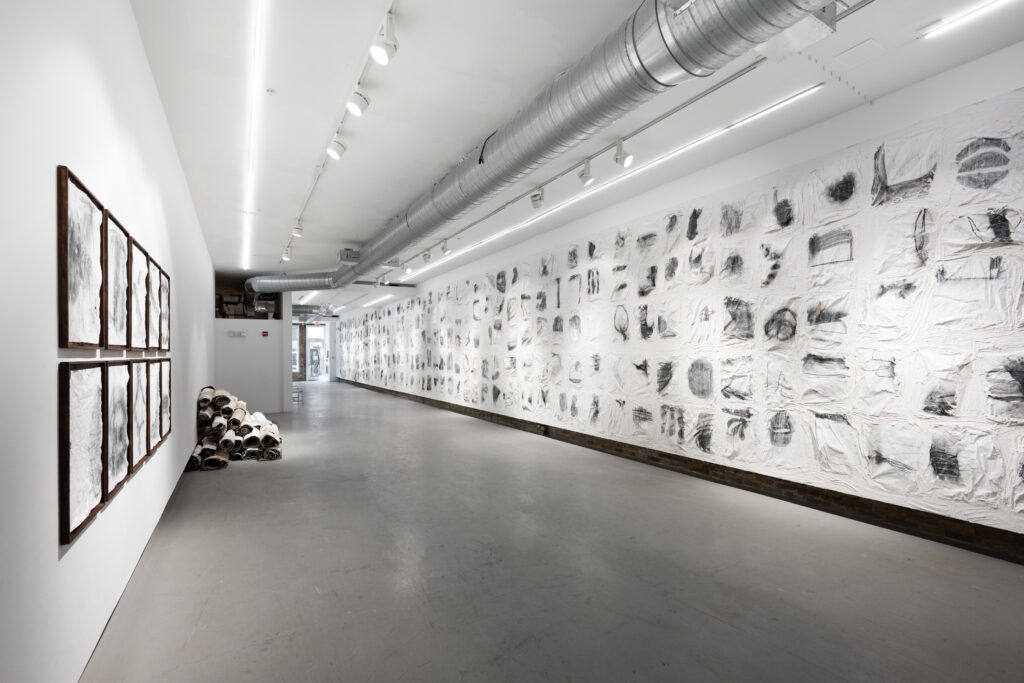
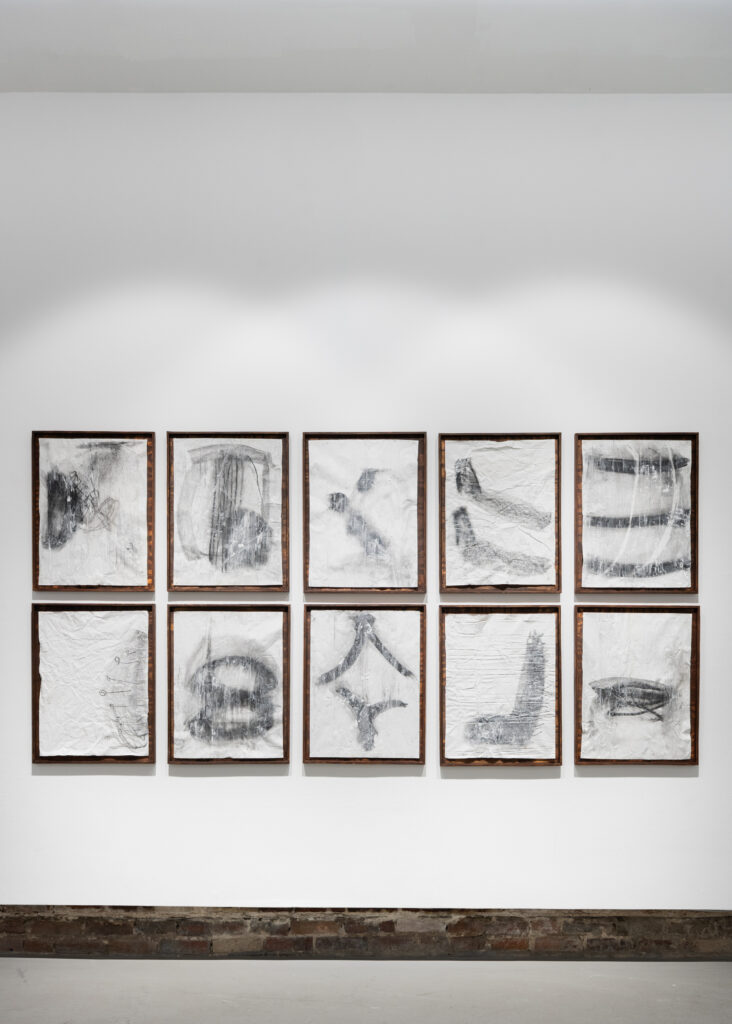
Installation view of “How to Hang a Drawing?,” Hamiltonian Artists, August 1-September 5, 2026. Photo: Vivian Marie Doering.
For June Canedo de Souza, drawing has always been a solitary, private practice, albeit a regular one. She admits to compiling and saving hundreds of drawings over the years, which she makes quickly and intuitively in the studio. The drawings are gestural and bold, with a charged use of line and dramatic tonal shifts between light and dark. With quick hand gestures, she smears the black pigment of the charcoal across the paper, seemingly following instinctive cues or a kind of logic that is foreign to me, and therefore, exciting.
In the process, I notice what seems like an evasion of composition. I ask Canedo de Souza about these abstract hand gestures that leave traces on the paper, and she generously explains, “I felt very limited by the English language and drawing offered another way to express myself.” I witness this drawing process firsthand in the gallery as she is preparing her large-scale wall installation, and the scratching sound of the charcoal against paper is visceral and satisfying. I feel as though I am lingering in a deeply intimate space, and have the impulse to back away and leave her with privacy. A drawing feels like a diary entry, its swiftness also signaling honesty.
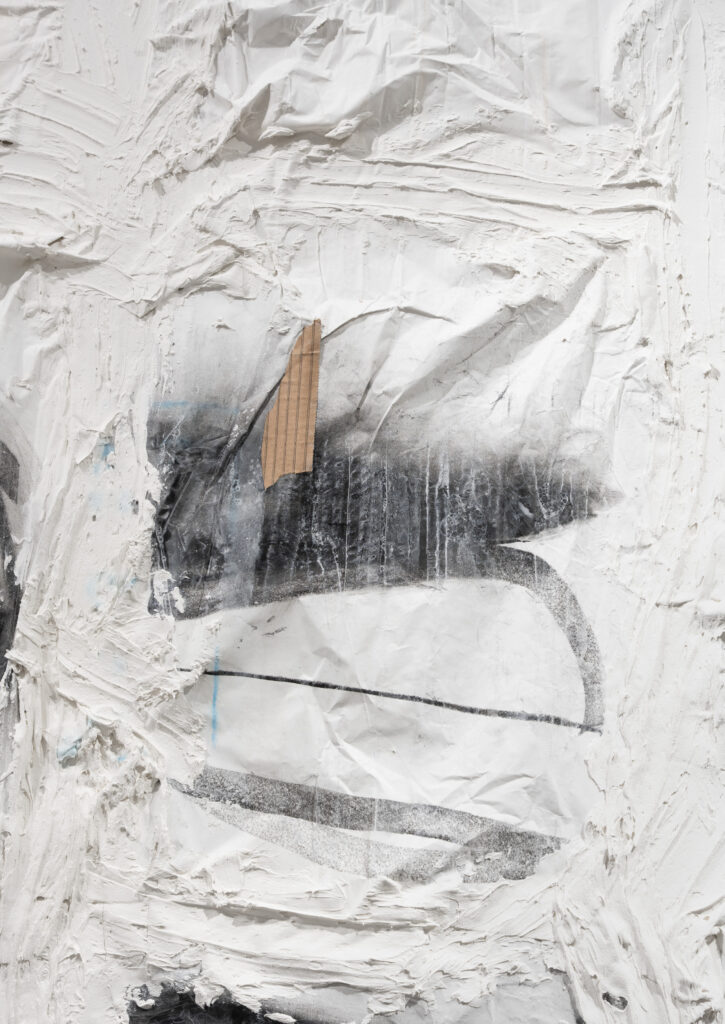
In How to Hang a Drawing?, Canedo de Souza destabilizes the implicit hierarchy of drawing and painting – inverting assumptions tied to value and the sellability of an object. Her mural-like installation is convincing in its scale and systematic approach. The artist makes an automatic drawing; the paper is dipped into a bucket filled with gesso, plaster, and water. It emerges, dripping, and is laid out carefully onto a flattened sheet of recycled cardboard. The cardboard surface is a palimpsest retaining printed barcodes and logos, ripped packing tape, and frayed, corrugated edges. In a laborious full-body motion, Canedo de Souza starts on one end of the sheet and rolls the cardboard tightly into a compact cylinder, the wet drawing dripping liquid out from the edges.
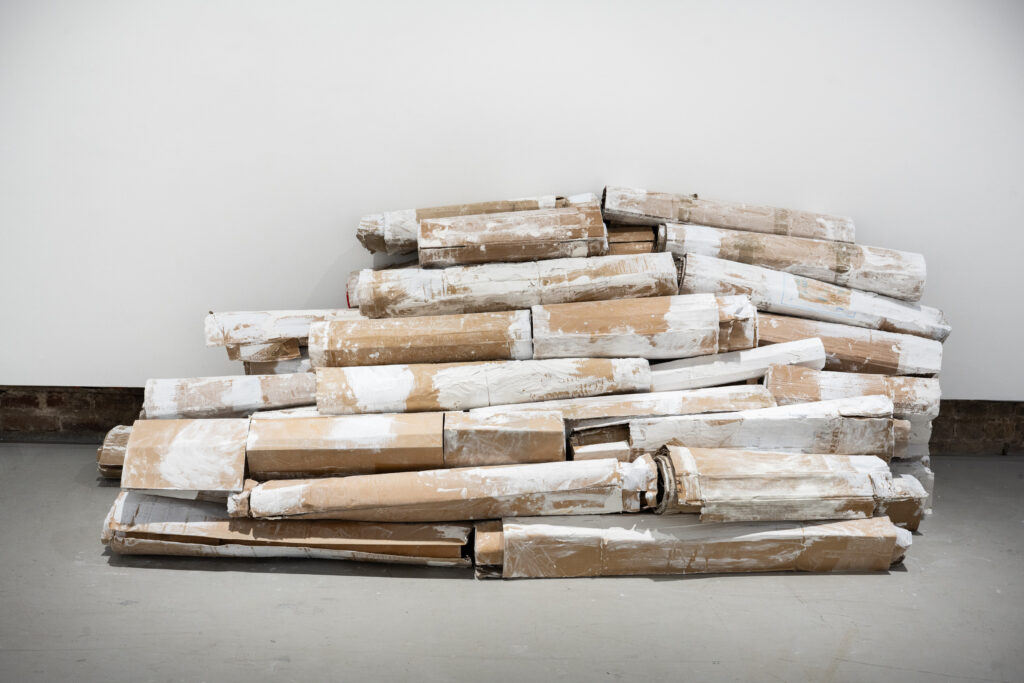
June Canedo de Souza, “Bottom left sway left to edge up two three seconds stop edge down one second edge bottom middle jolting up again right shaping out a moon or a balloon or a womb or a paper lamp the shape of those two three or four times kneed erasure pressure to paper to surface palm wipes clear its residue leaving other moons and balloons in its place five more times sharp curve to line down center. Stop. Repeat.” (2026), cardboard, joint compound, gesso, variable dimensions. Photo: Vivian Marie Doering.
After some time drying, each roll is carefully unfurled, and the drawing is peeled from the inside, revealing impressions on the paper from the cardboard – transfers of ink, embossment from folds, wrinkles, tears. Though they are the tools used during the making process, Canedo de Souza decides to include these cardboard cylinders in the final exhibition, stacked against a wall like construction materials in a work zone. How to Hang a Drawing? makes visible the artist’s hand, the hours of labor, the intermixing of materials.
Installation view of “How to Hang a Drawing?,”Hamiltonian Artists, August 1-September 5, 2026. Photo: Vivian Marie Doering.
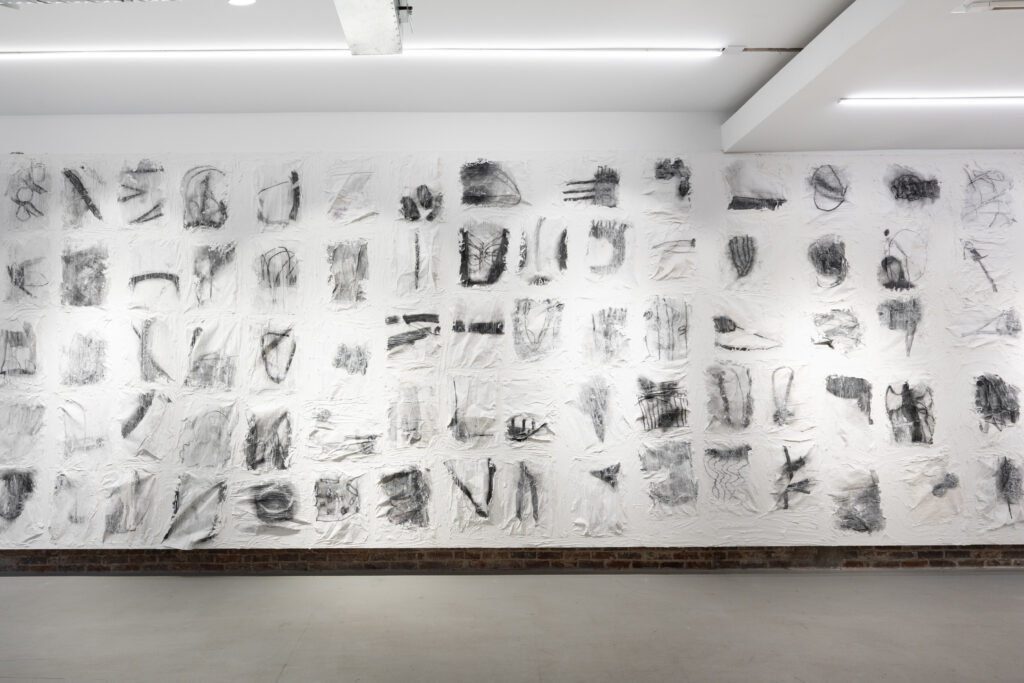
A counterpart on the opposite wall, long and imposing with a width of 97 feet is the exhibition’s monumental installation. Over 300 drawings, somehow maintaining the centrifugal energy of the laborious process they have been subject to despite being re-flattened, are affixed onto the drywall. Using joint compound applied with her bare hands, Canedo de Souza installs the drawings from floor-to-ceiling, sealing their edges with thick dollops of the white putty that look like impasto. The result evokes a grid of panels, simultaneously bringing to mind various human-designed systems like hieroglyphs, adobe construction, and window glazing. These associations are aided by the architecture of the long, commanding wall, but the drawings feel familiar and spontaneous––like the intermittent patterns that reveal themselves when you close your eyes after accidentally looking at the sun.
Installation view of “How to Hang a Drawing?,”Hamiltonian Artists, August 1-September 5, 2026. Photo: Vivian Marie Doering.
Inspired by children’s play and material curiosity, the drawings resist any formal resemblances. Instead, they read like symbols beyond our understanding, though they undeniably carry the presence of the artist’s own hand. Canedo de Souza’s fingertips are imprinted everywhere––in the smudged charcoal, the slathered gesso, and the dense joint compound. These physical forms are important. If abstraction is a process of disorientation, for Canedo de Souza, materials––not just the forms––too carry this charged potentiality. I ask her about this, and she replies, “Abstraction for me is expansive. It allows me to move beyond. I used to be intimidated by it, but it’s actually a very simple way of thinking or feeling.”
Curiosity and play are strong undercurrents in this “simple” form of expression. Simplicity does not mean reductive or easy. Instead, Canedo de Souza’s work suggests that it is intrinsic, yet perhaps often suppressed. The artist is inspired by the work of the late British sculptor Phyllida Barlow, who was herself a mother of five. Known for her abstract, large-scale sculptures frequently incorporating cement and other industrial materials, she often spoke about the limited time she had at the studio during her early years of motherhood. Within those finite moments, Barlow leaned into chaos. She once said, “My relationship to sculpture always has to be adventurous, always on the edge of being out of my control.”1 Perhaps Canedo de Souza’s work is guided by a similar maternal impulse, an energetic acceptance of mayhem and the unknown.
Installation view of “How to Hang a Drawing?,”Hamiltonian Artists, August 1-September 5, 2026. Photo: Vivian Marie Doering.
Through invented forms of mark-making and juxtaposition, Canedo de Souza’s work considers: What are the material limits of water, paper, plaster, and how might we experiment with their formal capacities? How can these experiments destabilize our construction of self, home, and the built environment around us? What can play and, by extension, chaos offer us in creativity and everyday life? Typically ephemeral and meant to communicate a preliminary idea, in Canedo de Souza’s installation the drawing instead becomes the architectural vertebrae––figuratively and literally carrying weight. It is a spinal column conceptually anchoring diverse processes but also an allusion to a literal spine––to Canedo de Souza’s arduous, bodily process of bending over, dipping, rolling, unfurling, peeling, layering, plastering, smudging.
In her studio, using charcoal and oil pastels, the artist treats drawing as the necessary first hour. She moves from paper to paper, one drawing made within minutes of another. Presence is altered when material, body, and surface connect; many a drawing is made.…