

Past Exhibition
PANG
Madyha J. Leghari’s solo exhibition PANG examines the tenuous and contradictory ethos of what is deemed natural in contemporary gestational and birthing practices. It critiques…
The two-year Hamiltonian Artists fellowship has been a period of gestation for Madyha Leghari. Demanding on the mind and body, the time of incubation culminated in the birth of both her baby and an expansive new body of work. Abundant and thought-provoking, these entwined labor-intensive processes constitute a philosophical journey, materially and conceptually rendered in her solo exhibition titled PANG.
An emotive and descriptive word, ‘pang’ is a sharp, sudden pain associated with transition. An initial glimpse of the exhibition suggests a descriptive journey that unfolds through depictions of anatomical changes and biological processes during pregnancy. However, upon closer inspection, the poetic text and subversive gestures reveal layered connotations that extend beyond the physical into psychological, political, and defiant realms.
The exhibition was installed in a long, narrow exhibition space that symbolically resembled a passage, flanked by slanted partition walls, offering partial views of the show. The viewer was invited to move through a sensorial and critically stimulating experience accompanied by the sound of liquid dripping, falling, and splashing, vibrant with the faint scent of soil. This combination lent the atmosphere humidity and created a palpable sense of wetness.
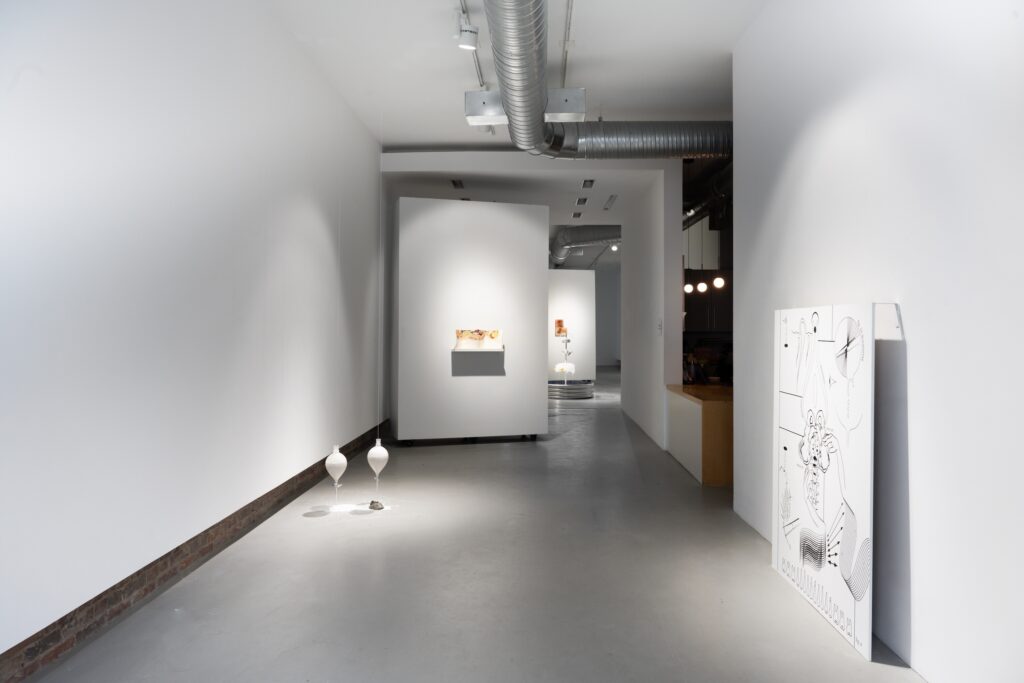
Throughout the exhibition, the reproductive body mirrored the nurturing and breeding forces of land and water. Historically, and in the contemporary moment, land and water continue to be categorized as valuable resources that are consistently weaponized, surveilled, and controlled in similar ways with interchangeable logics and vocabularies. Across eleven works, Madyha navigated the emotional, physical, and social pressures of production alongside its politicized dimensions, offering a compelling meditation on creation as both an embodied experience and a critical inquiry. 1
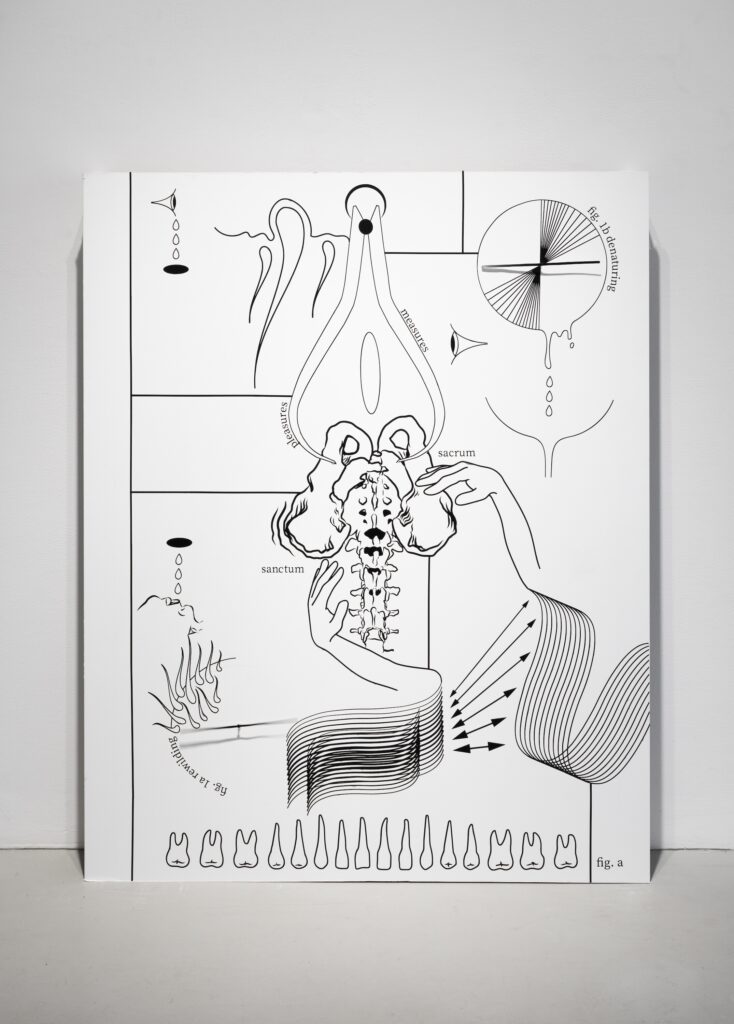
A black-and-white diagram printed on a 60 by 48 inch vinyl sheet, mimicking an exhibition poster, greeted the visitor upon entering the space. This work, Re/Wilding/De/Naturing, functioned as an index of the display, capturing the multiple strands of inquiry and outlining the core intentions of this new body of work. Here, Madyha adopted the formal etiquette of diagram-making while subverting scientific accuracy into an ambiguous orientation and abstract arrangement, composing select elements that captured the essence of the exhibition into an image. Apart from defining the conceptual premise and acknowledging the somatic and psychological weight of procreation carried by the gendered body, the title of the work is a provocation to reconfigure preset perceptions, asking what is promoted as nature and natural by capitalist and patriarchal logic?
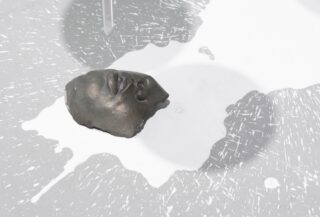
In her book, Caliban and the Witch: Women, the Body and Primitive Accumulation, Silvia Federici elaborates on the capitalist shifts that defined female bodies as profit-generating reproductive vessels equated with cattle and land — an extractable resource for a future labor force to sustain industry and state armies. The Leak by Madyha is a potent reminder of how a female body is viewed as a source of production and nourishment. An open-mouthed bronze cast is placed on the floor, as if partially emerging from the ground, with two round-shaped separatory glass funnels hanging above it, half-filled with white fluid that drips in and around the mouth. This seeping liquid creates small pools and splashes on the floor, indicating the continuous labor of sustenance throughout gestation and post-birth. Yet the body defies restrictions on its capacities and rigid formations with its elastic aqueous nature that nourishes life within and beyond itself.
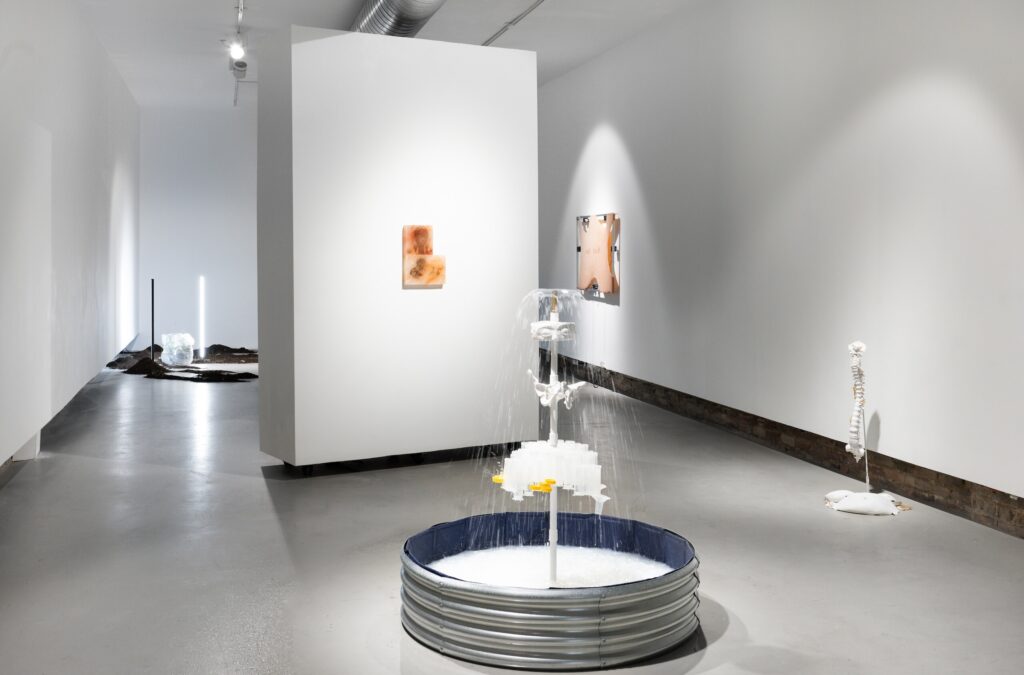
Another work, A little makes a lot of sea, denotes the various cycles, transitions, and capacities of the female body. This fountain, spewing white liquid, is divided into three tiers: a sculpted polymer-clay face at the top, an anatomical model of the pelvic bone in the middle, and numerous breast milk storage vials lassoed upright at the bottom. The tower stands in the center of a child’s pool nestled within an iron garden bed. The liquid flows through each site, gathering for brief moments into the pool while it continues to resist confinement and splashes outside the container. There is a porousness defined by the consistent accumulation and leakage of sustenance or discharge through tears, milk, blood, or amniotic fluid. These aqueous flows are agents of the regenerative powers that sustain human life.

According to Federici, the commodification of the female body entails its weaponization and exclusion from property and wage that is increasingly enabled by the structuring of gender hierarchies, consequent gender roles, and the introduction of respectability politics. Gender segregation assigned reproductive labor and care work to women, justifying it as a natural biological and emotional process that must be accepted as a duty and social responsibility performed out of primal instincts and maternal love; therefore, deemed non-work and hence unpaid.2 Time and again, new trends resurface that reinforce these ideologies, translated and transmitted through popular media that makes it widely accessible and socially acceptable. Madyha challenged these perceptions with this new series of works that reclaim agency systemically withdrawn from women.
In her critique, she specifically mentions “the ‘tradwife’ movement, a social media–driven subculture led by housewife influencers who promote heteronormative relationships and traditional gender roles, weaponizing the construct of nature under the guise of wellness and DIY practices to enforce submission.”3 This exclusionary and alienating rhetoric demonizes everyone who does not fit the set image or rebels against it. It further undermines the intellectual labor of women and disregards their emotional well-being by manipulating them psychologically. Contrary to the dominant opinion, it remains a person’s choice to tap into their capacities, which are not limited to biological nurturing but extend to the mind and tongue that exercise agency by challenging notions of world-making.
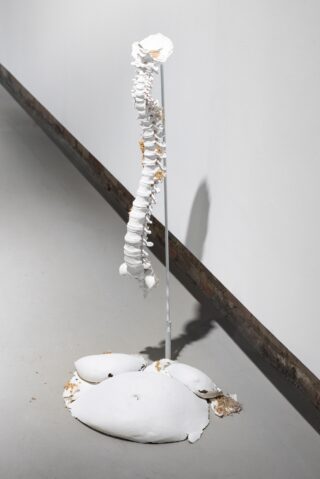
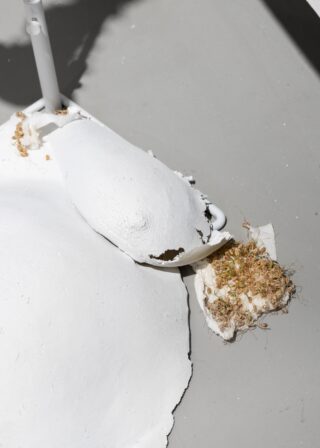
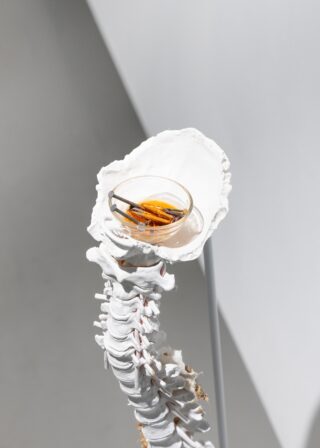
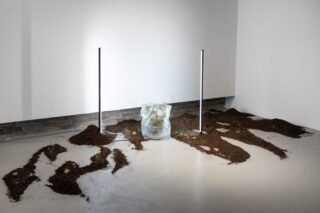
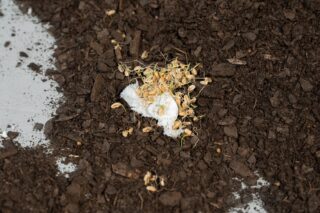
Mothertongue and The atlas bone,placed adjacent to each other, reflect on these notions and the necessary labor of ‘renaming’ the world.4 The former is an archival digital print portraying the anatomy of a pregnant woman, in which the fetus resides in the brain cavity, and an atlas is placed in the belly. Poetic annotations and fleeting avowals bracket each part of the body. The latter is a sculptural work featuring a deflated, fiber-filled resin cast of the pregnant torso that seems to have slipped off an upright spinal cord, pooling around the feet on the ground like shed skin. The uppermost bone in the spine, known as the atlas, which supports the brain, here hosts a small glass bowl with iron nails rusting in baby drool. Alongside, wheatgrass is growing in patches along the spine and the cast.
Both these works signify the complexities and intrusions in the cycle of life. It indicates the dichotomies that are personally and socially attached to, and imposed upon, procreation, such as the responsibility of exhausting the planet with an additional life while also bearing the burden of sustaining evolution. This further equates postpartum depression with climate grief. The play of language and metaphorical placement of visual and sculptural elements depict the transformative power and agency of nature: the placement of the fetus in the brain, the growing wheatgrass, and baby drool transforming metal. It simultaneously recognizes the monumental responsibility underlying these transformations that shape the world at large.
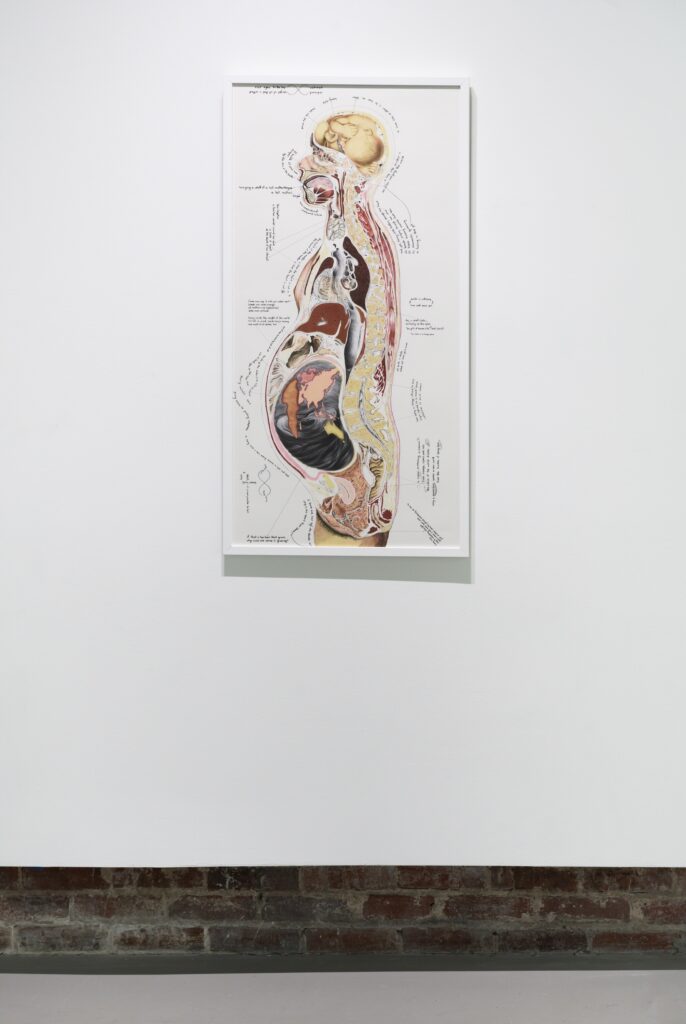
The fetus’s orientation to the world begins in the womb. “The first sensorium to be developed in a fetus is the auditory, through low-frequency sound exposure emerging from the mother and the outside world, softened and protected by the amniotic fluid. These initial encounters with sound are an attunement and preparation for entering a new abode where the being is introduced to circadian rhythms, lullabies, and laments in the process of shaping the architecture of being together with other life forms and forces.”5 Both works signify a consciousness of the impact, capability, and influence of a new life on the world. For the woman bearing a child, this tangible and intangible weight leads to a shift in gravity, both physically and psychologically, a recalibration of the sheer force and capacity that enable life-altering change. However, this consciousness and acknowledgment are consistently and systemically suppressed by powers that control bodies and minds.
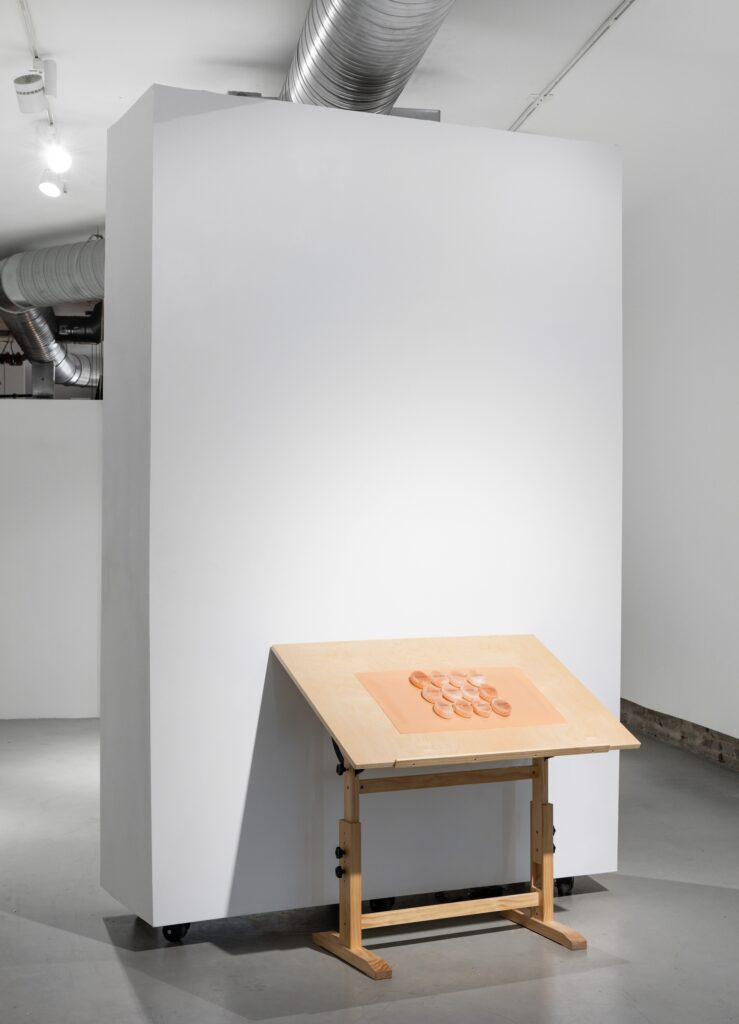
The colonial extractivist logic that treats women as a resource, equating and even substituting them with land,6 is enabled by the desacralization of nature: the rupture of the interdependent and inseparable human-nature bond through commodification and reduction to material source. Salt of the Earth engaged this logic through twelve Himalayan rock salt massage stones etched with words that collectively formed a poem. The rock salt is the residual formation of an ancient inland sea that evaporated 600 million years ago, carrying the afterlife of a vanished sea while continuing to provide enduring sustenance in its various forms, reflecting its abundant capacities and persistence. Madyha’s choice of material carries conceptual weight through both its politicized name and its relationship to the inscribed words, collating the sea and the womb into poetic and material correspondence. Sourced from the Khewra salt mines in Pakistan yet marketed as Himalayan pink salt, the material’s origins are obscured to placate political affiliations and maximize market demand, situating the work within the extractive processes it invokes. The invitation to rub the stone between the fingers extended this critique into an embodied encounter. Body warmth produced a moist stickiness that left salt deposits on the skin, bringing the sea and the body into contact. The humid atmosphere reactivated the stone’s geological memory, transforming its solid state into sweat, collapsing the distance between ancient sea, land, and body.
Capitalist and patriarchal ideologies trivialize the many stages of physical and psychological struggles experienced by female bodies, normalizing them as a common and natural occurrence. This contradiction is mirrored in expensive routine procedures and the persistent gaps in medical research on female anatomy, which is often treated as secondary despite its complexity and continual changes. It extends into state policies, many of which have historically been shaped by male-dominated institutions, as evident in the increase in anti-abortion legislation across the world. Across these structures, the emphasis remains on maximizing extraction potential, rather than prioritizing well-being, relief, and bodily autonomy.
In the final work of the exhibition, Inhospitable Womb, Madyha challenged the alienation within medical terminology. A transparent resin body cast held herbal abortifacients, also known as labor-inducing herbs, growing in the womb. Their label is determined by the gestational stage at which they are consumed, while their function remains the same. The duality of language upholds resistance in its entanglements. The work is a critical reflection on the wellness industry and the cultural conditioning connected to nature, where knowledge is imparted in a linear, commodified fashion, remaining selectively curated rather than as an embodied knowledge system.

The interconnectedness of mind<>body and body<>land denotes a capacity to birth and nurture that can transform and create multiple worlds. Colonial, capitalist, and patriarchal structures exercise power and control by segregation, and reworlding threatens that order. Countering the hegemonizing isolation and categorization, Madyha pulls them together in recognition of their potential and interdependency. Language and science are mobilized as tools of surveillance, control, and alienation to embed a curated image and set of associations in the social psyche, enabling extraction and exhaustion. The poetic interventions and material associations rendered in titles, captions, and artworks throughout this new series subvert and demystify such constructions. By generating a sensorial presence and reference to moisture throughout the exhibition, Madyha transmits a radical reminder to the thinking self of the forces that underlie all creation.
Hajra Haider Karrar is a curator and writer invested in articulating questions that destabilize and reconfigure colonial and capital paradigms that lay at the foundations of knowledge production by working through ancestral and affective epistemes.
Past Exhibition
Madyha J. Leghari’s solo exhibition PANG examines the tenuous and contradictory ethos of what is deemed natural in contemporary gestational and birthing practices. It critiques…